
Building Materials Cost in Nigeria Is Rising Fast. Here Is What Every Builder Needs to Know

A frank look at what is happening to the cost of construction in Nigeria, and the practical steps builders, developers, and contractors can take to protect their projects.
If you have priced materials for a project recently, you already know something has changed. A bag of cement that cost around ₦7,500 in the last quarter of 2025 now sells for between ₦11,500 and ₦15,000 in many parts of Nigeria. Steel prices have risen by approximately 20 percent in a single quarter. Sharp sand by roughly 25 percent. Granite, wood, and transportation costs have followed the same upward curve.
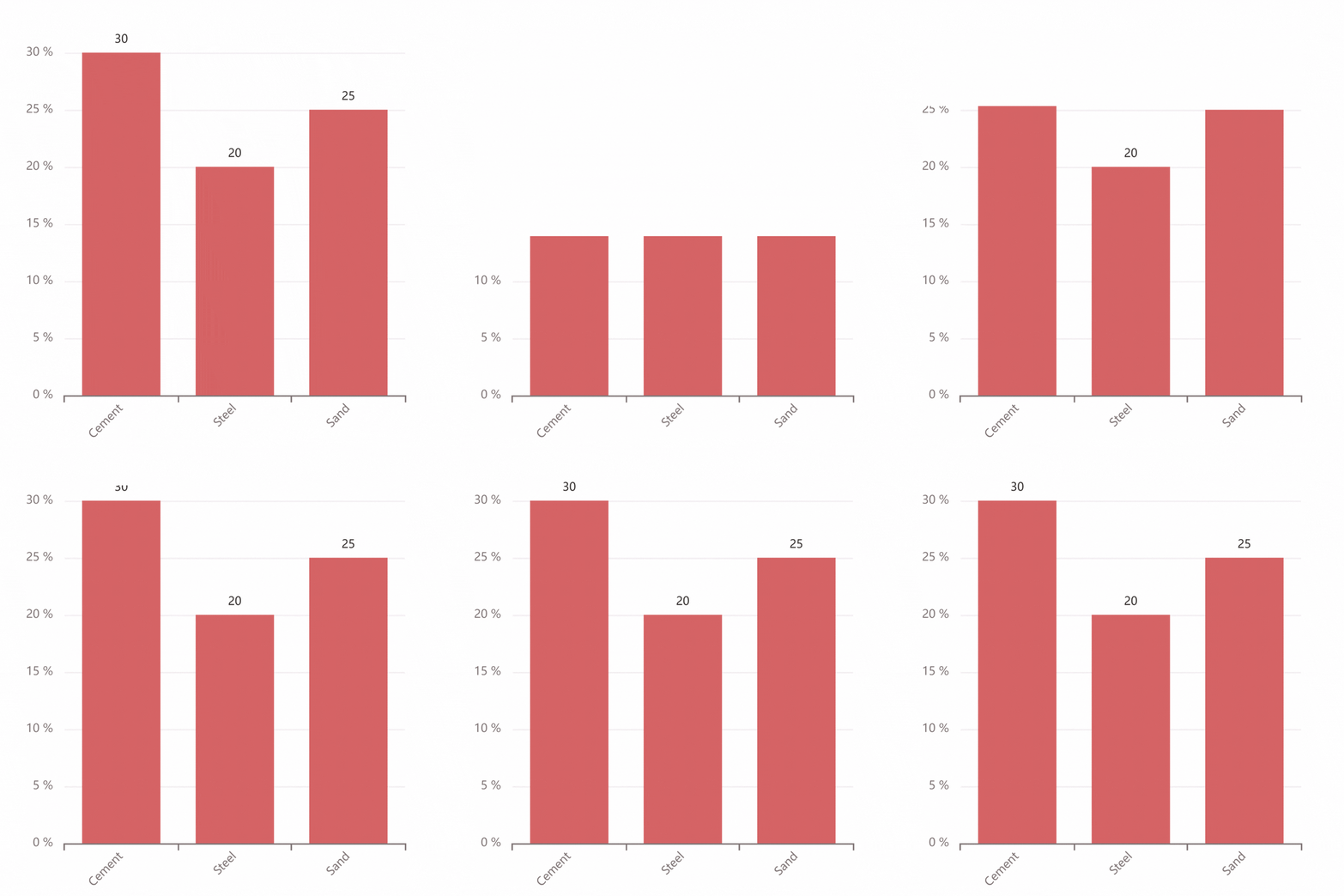
This is not a temporary fluctuation. It is a deepening structural crisis, one that is stalling projects, pushing housing further out of reach for millions of Nigerians, and placing builders under a kind of financial and professional pressure that rarely gets named clearly enough.
In this post, we want to do exactly that: name it clearly and then tell you what you can actually do about it.
What Is Driving the Building Materials Cost Crisis in Nigeria?
Understanding the root causes matters – not just for context, but because it helps builders make better decisions in a volatile market.
Market concentration at the top
Nigeria’s cement supply is heavily concentrated. A small number of manufacturers control approximately 95 percent of the market. When pricing power is that concentrated, producers have little competitive pressure to bring costs down, even as builders and developers feel the consequences of every price increase. Industry observers have noted that Nigeria’s major cement manufacturers recorded combined profits of over ₦1.64 trillion in 2025, even as construction projects across the country slowed or stalled entirely.
Fuel costs driving everything downstream
The cost of building materials in Nigeria does not begin at the manufacturer’s gate. It begins at the quarry, the mine, the plant, and it accumulates at every point where a vehicle moves materials from one place to another. With petrol prices in some parts of the country reaching between ₦1,150 and ₦1,500 per litre, transportation has become one of the most significant cost components in the entire supply chain.
Every kilometre a material travels adds cost. In a country the size of Nigeria, where supply concentration means some regions depend on cement transported from far away, those kilometres add up fast.
Currency pressures and imported inputs
Despite Nigeria’s significant local limestone reserves, cement production still depends on imported chemicals, equipment, and technical components. Currency volatility adds an unpredictable layer of cost to everything that crosses a border, and that cost, like all others in the chain, eventually reaches the builder.
Infrastructure demand competing with residential supply
Large-scale government infrastructure projects: road construction, bridges, public buildings, compete for the same materials and the same supply chains as residential and commercial developers. When demand surges from multiple directions at once, supply struggles to keep pace. Prices rise. And the builders working on private projects absorb the consequences.
The Human Cost: What the Numbers Are Not Telling You
The statistics around building materials cost in Nigeria are sobering. But behind every number is a story that deserves to be told plainly.
More than 28 million Nigerians currently lack access to adequate housing. Over 11,856 construction projects have been abandoned across the country, not because developers lost interest, but because the cost of completion became mathematically impossible on the budgets they had committed to.
Urban rents have more than doubled in recent years. In Abuja, a self-contained apartment that rented for around ₦400,000 per year now costs between ₦800,000 and ₦1.5 million. The people who cannot afford to build are also finding it harder to afford to rent.
Also, there is a quieter risk that industry voices have begun to raise more urgently: when building materials cost in Nigeria rises beyond what builders can responsibly absorb, some are tempted to substitute quality materials with cheaper, substandard alternatives to stay within budget. The building gets finished, but the structural integrity, safety, and longevity of that building carry the hidden cost, borne not by the builder, but by everyone who lives or works inside it.
This is not a hypothetical concern, it is a documented pattern in markets under sustained cost pressure.
What the Industry Is Calling For
Construction and housing stakeholders, real estate developers, and industry associations have been vocal in calling for government intervention. Specifically, they have urged the Federal Ministry of Housing and Urban Development to engage manufacturers and key players in the construction value chain to stabilise prices, review the market concentration dynamics in cement production, and introduce policy incentives that support local manufacturing capacity and reduce dependence on expensive imports.
These are legitimate and necessary conversations at the policy level. Real and lasting change to the building materials cost environment in Nigeria will require structural reform, not just short-term price controls.
But policy timelines move slowly. Projects do not wait.
You should not have to choose between finishing a project and finishing it right
What Builders Can Do Right Now
While the structural issues work their way through the policy process, there are practical steps builders, contractors, and developers can take to protect their projects and their cash flow.
1. Get a fresh materials quote before committing to any client pricing
The building materials cost environment in Nigeria has shifted significantly enough in recent months that estimates from the last quarter, or even the last six weeks, may no longer be accurate. Do not build a project budget on outdated prices. Get current quotes before you commit to a figure with your client.
2. Buy closer to the source:
Every layer between the manufacturer and your site adds cost. Direct purchasing relationships with manufacturers, or working with platforms that source directly from manufacturers, can meaningfully reduce the price you pay compared to buying through multiple intermediaries. More affordable does not mean lower quality, it means fewer markups between the factory and your project.
3. Use credit schemes designed for builders:
One of the most damaging effects of rising building materials costs is the cash flow disruption they cause. A contractor who mobilised on last year’s prices cannot always absorb the difference between what was budgeted and what materials now cost. That gap does not have to mean a stalled project. Build-to-pay credit arrangements, where builders access materials now and pay later on terms that align with their project timeline, are specifically designed for moments like this one.
4. Do not substitute materials to close a budget gap:
This bears repeating directly: the liability for a building’s structural integrity stays with the builder long after the keys are handed over. If costs have moved beyond what the original budget can support, the right response is to renegotiate the contract, revisit the scope, or seek financing, not to compromise on what goes into the walls. A building that fails is a far more costly outcome than a project that took longer to fund properly.
5. Plan further ahead on material procurement:
Price volatility rewards builders who secure materials early. Where your project timeline allows, consider ordering key materials, particularly cement and steel in advance of when you need them on site. Holding costs are manageable. Mid-project price surges are not.
How Build Africa Is Responding
At Build Africa, we are not standing to the side of this crisis and watching.
Our business model is built on two principles that matter most in a high-cost, volatile market: direct manufacturer relationships and transparent pricing.
We source directly from manufacturers. There are no intermediaries adding layers of margin between the factory and your order. The price you see from Build Africa is the honest price, more affordable because the supply chain is shorter, and transparent because we have nothing to hide on what we pay and what we charge.
Also for builders navigating the cash flow challenges that come with rising building materials costs in Nigeria, the Build Africa Credit Scheme (BACS) provides access to materials now with payment terms designed around project timelines, not supplier preferences.
We built BACS precisely for moments like this one. Because builders who are doing the right things, sourcing quality materials, managing projects professionally, building structures that will stand, should not have their projects stalled by a market environment that is largely outside their control.
The Bottom Line
The building materials cost crisis in Nigeria is real, it is ongoing, and it is not going to resolve itself quickly. Builders who understand what is driving it, and who take practical steps to manage its impact on their projects, will be better positioned to keep building responsibly, on time, and on terms that protect both their clients and their own businesses.
Dear Builder,
The market is difficult, but you are not navigating it alone.
If you have a project in progress or in planning, we are here to help with honest pricing, quality materials sourced directly from manufacturers, and the BACS credit scheme for builders who need to keep moving.
Get a materials quote today (Chat on WhatsApp), or learn more about BACS at buildafrica.store
Sources: The Whistler, BusinessDay, Vanguard, Legit.ng, Africa Health Report, Guardian Nigeria – all citing industry data from REDAN, CHSD/University of Lagos, and NAN market reports, Q1 2026.